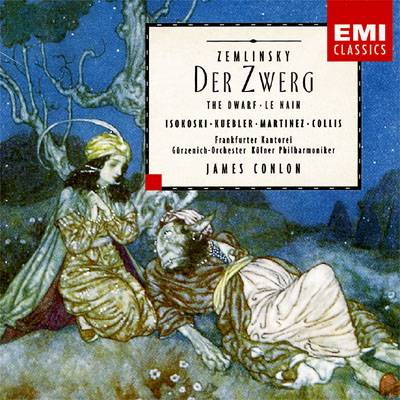
Alexander von Zemlinsky:
Der Zwerg (The dwarf)
Tragic tale for music in one act, free after Oscar Wilde's "Birthday of the Infant" by Georg C. Klaren
Isokoski, Kuebler, Martinez, Collis
Women's Choir of the Frankfurter Kantorei,
Guerzenich Orchestra Cologne Philharmonic
James Conlon
EMI
James Conlon, chief conductor of the Guerzenich Orchestra and the Opéra National de Paris, one of the leading conductors of his generation, had already worked with the Frankfurter Kantorei in 1995 when he performed Britten's "War Requiem". He remembered the transparent sound and the choir's professional manner of working. So he engaged the women's choir for the chorus parts (retinue of the infant) for the production of Zemlinsky's opera "Der Zwerg" (The Dwarf). Parallel to the recording sessions in the philharmonic hall of Cologne in February 1996 there were three live performances of the opera. They were, 54 years after the composer's death, the first performances of Zemlinsky's final version.
This work, tightly related to Zemlinsky's own biography, has a varied history. For decades it has been performed in a distorted version under the title "The birthday of the infant". Obviously the composer did not notify numerous retouchings after the first performances in the 1920s to the publisher. So they were forgotten. The center figure of this tragic tale is a deformed dwarf who, unaware of his appearance, believes to be a beautiful prince. He is the infant's birthday present. He is meant to amuse her, but he is strongly aroused by her. Of course his love must end tragically when she tells him the truth about his appearance.
James Conlon says about this piece that it is "unsurpassed in it's period of time", "strict in it's dramatic structure and of well balanced proportions. Text and music are well suited to each other, the musical, dramatic and formal elements are seamless. The vocal arrangement sounds unforced and smooth, the orchestra is brilliant and as imaginative as Richard Strauss' and Mahler's." The strict dramatic structure is nontheless a consequence of the "real-time"-composition: The plot lasts as long as the performance of the opera. The listener experiences this birthday afternoon without any interruptions or time-leaps.